


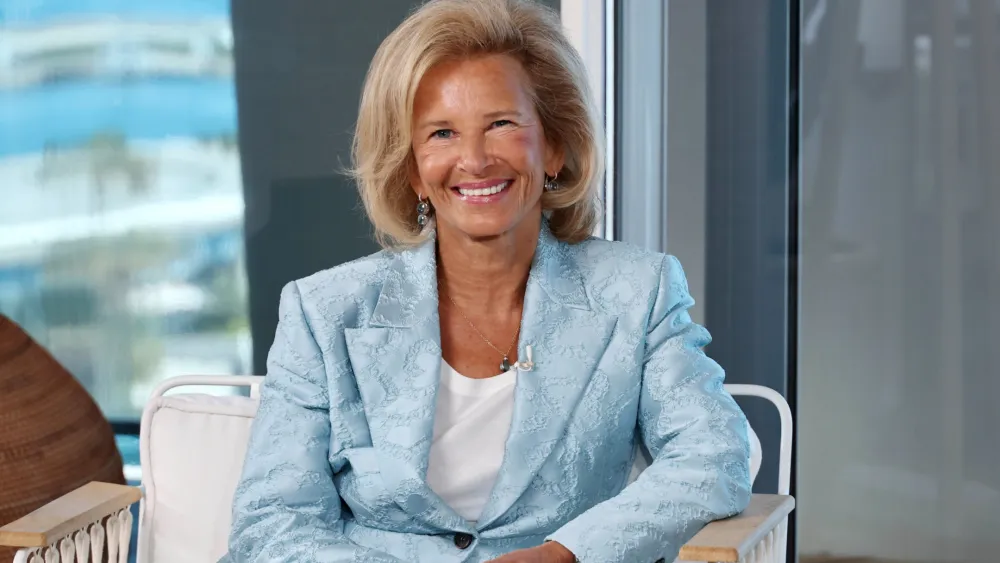
There may be no studio logos on the Croisette this year, but don’t tell that to Iris Knobloch. A little over three years into the job, the Cannes Film festival president, who spent decades working for Warner Bros., isn’t buying the narrative of an American retreat from Cannes. “There are almost as many American films as usual,” she says, pointing to the 11 U.S. titles in this year’s official selection and arguing that Cannes remains an unrivaled launchpad for American independent cinema, as underscored by Sean Baker’s “Anora’s” sweep at the Oscars in 2025.
“What’s changed isn’t Cannes’ relationship with Hollywood — it’s Hollywood itself,” says Knobloch in an interview with Variety on the eve of the festival’s kickoff. As studios grapple with consolidation, shifting viewing habits and AI disruption, the festival has doubled down on its role as a global showcase. This year’s lineup will boast six films from Asia, one from Congo and four from Spain, while European and American stars increasingly populate international productions, like Cristian Mungiu’s English-language debut “Fjord,” featuring Renate Reinsve and Sebastian Stan; and Hong-jin Na’s “Hope,” with Michael Fassbender and Alicia Vikander. “Cinema is no longer compartmentalized,” she says. “It’s a very open ecosystem.”
And while the festival might lack some star power this year, the Palais and Croisette will serve as backdrop for Season 4 of Mike White’s “The White Lotus” whose plot will revolve around stars with movies playing in competition. “Cannes is no longer just a festival. It has become part of global pop culture and imagination,” she says, before revealing that she’s a fan of the show, especially the first season.
Asked about Cannes’ dress code headaches and nudity ban, Knobloch jokes that she has been receiving a steady stream of texts from talent asking if their sheer gowns or towering trains will pass muster on the red carpet. “We’re not trying to impose taste or dictate fashion,” she says.
In a wide-ranging conversation, she also speaks about Cannes’ stance on political expression after the Berlinale’s free speech controversies, why she hopes Netflix returns to Cannes for the festival’s 80th anniversary, and why the real conversation around gender parity isn’t about competition slots but access to financing.
“The White Lotus” is shooting in Cannes this year. That’s pretty incredible for the festival, right?
Absolutely. It shows that Cannes is no longer just a Festival. It has become part of global pop culture and imagination.
Especially in a year when everyone is saying, “There are no American studios.”
In reality, there are almost as many American films as usual—11 in the official selection, compared to 12 last year. It’s rarely been much higher than that. Cannes has proven its importance for American cinema, particularly independent films—just look at “Anora,” which went on to rack up nominations worldwide, including at the Golden Globes and Oscars. For American cinema, Cannes remains an unparalleled global launchpad.
So, what’s really happening with the studios?
I think American studios — not American cinema — are going through a particular phase. We’ve seen this many times in Hollywood; it’s cyclical. Right now, we are in a moment of transition linked to consolidation, changing viewing habits, and the rise of AI. There are also practical factors: is a film ready in time for Cannes? But it’s not a weak year at all—it’s actually a very strong year for American cinema overall. And as always, Cannes showcases films from all over the world: six from Asia, one from Congo, four from Spain and more. Some years a country experiences a creative explosion. This year Spain is one of them. The key is offering a platform to global cinema.
And some of those international films showcase American stars.
Exactly. That’s what’s changed — American stars are everywhere, just as European actors appear in American films. Cinema is no longer compartmentalized. It’s a very open ecosystem, and you’ll see that clearly on the red carpet this year.
When you were at Warner Bros., did you experience similar transition periods? Times when studios hesitated about festivals?
Yes, for various reasons. Sometimes it’s about budgets or risk-taking. There are also periods when studios are focused on large-scale franchise film making..
This year, several Oscar contenders didn’t go through festivals — “One Battle After Another,” “Sinners”… Maybe studios feel they don’t need festivals anymore?
I don’t think anyone goes to a festival just to get to the Oscars—it’s not that simple. Cannes amplifies a film’s presence—its commercial success, its visibility, its cultural impact. Think about Tom Cruise last year: even for a film that’s already an event, Cannes transforms a release in a cultural moment. Awards come afterward. And recently, Cannes has boosted both awards and box office results.
It’s interesting that some of the most talked-about Oscar films this year weren’t American. Cannes also creates international surprises.
That’s precisely its role: to spotlight films that might not otherwise reach a global audience. Would Sentimental Value have had the same impact without Cannes? Probably not. Same for “Secret Agent,” which might have stayed confined to Brazil. What is important is that cinema allows perspectives to travel. A viewer in Seoul can suddenly encounter a Brazilian reality; and someone in Europe can discover a Norwegian sensibility. In a world that’s becoming more inward-looking, cinema plays a crucial role, and Cannes gives those films a chance to travel.
Speaking of studios, there’s talk that Warner was “traumatized” by the reception of Joker 2 in Venice. Do you think that’s made them more cautious?
I can’t speak for Warner anymore, but they’re a good example of a studio navigating another profound transformation. Following the merger, they are focused on defining what the next chapter will look like. That naturally leads to caution. Moments like “Joker”’s reception can have an impact, of course.
But Cannes’ strength is that Thierry Frémaux and the selection committee are working closely with studios, producers and distributors to make the right decision for each film. What matters most to us is the film’s success.
You spoke at the press conference about the festival’s role in fostering dialogue, especially in a tense global context. What did you mean?
The festival’s core mission is freedom of expression and creation. In today’s world constructive dialogue has become very difficult.Opinions differ, but there’s little space for exchange. Cinema — and the Cannes Film Festival —allow opposing views to coexist and be discussed. Films carry political messages about power, humanity, the world today and tomorrow. Showing 75 films from 54 countries over 12 days and exposing films from different cultures and perspectives is an act of faith in the power of cinema.
The festival is a place for debate. That’s why it was created in 1939, at a time when freedom of expression was under threat.
After what happened in Berlin, do you see any risk of similar tensions in Cannes?
I don’t see it that way. Cannes has very clear principles: the independence of the selection committee is non-negotiable. Its only compass is artistic excellence. We also have a strong governance structure to protect that independence. And we would never question an artist’s right to speak about their work and convictions.
Cannes is a nonprofit, right? And do sponsors have any sort of influence?
It’s a nonprofit association with public funding and strong independence. And sponsors—never.
You’ve also avoided the kind of politicized tensions seen elsewhere, for instance at press conferences. Do you actively manage press conference questions?
Anything can happen, of course. But Cannes is fundamentally about celebrating cinema and letting films speak. And no, we don’t manage questions at press conferences. We’re fortunate that journalists here are deeply cinephile and genuinely interested in cinema.
This year, there are five films by women in competition…
Focusing only on competition is reductive. Across the official selection, women represent 34% this year, up from 26% last year. In Un Certain Regard, with 58% we’ve surpassed parity.
The real shift is generational. More women directors are emerging Visibility is no longer the core issue. Access is.Access to funding, access to projects. That’s beyond Cannes—it’s up to the industry.
Finally, what about streaming platforms?
They’re welcome, as usual. The only rule for competition is a theatrical release in France. Otherwise, films can screen out of competition or in other sections.
The ecosystem is evolving. Amazon is investing heavily in theatrical releases. Even Netflix is engaging more with exhibitors. For me, theatrical and streaming complement each other. One creates an event, the other expands access.
Do you think Netflix could return to Cannes?
I’m hopeful. Maybe for the 80th anniversary.
And the commitment to theatrical releases remains?
Absolutely. It’s fundamental. At a moment, when everything isolates us, the collective experience of cinema matters more than ever.
How meaningful is it for you to honor Peter Jackson and Barbra Streisand on opening and closing nights of the festival, and have Park Chan-hook presiding over the jury?
Our jury president Park Chan-wook, alongside Peter Jackson and Barbra Streisand, perfectly embodies what this year’s festival represents: artistic ambition on one hand, and openness to the world and diversity of voices on the other. Barbra Streisand broke through glass ceilings before the expression even existed. She is a complete artist — singer, actress, producer and director — who forged her own path in an industry that was not always welcoming to women, while remaining deeply true to herself.
Peter Jackson reminds us that technology alone means nothing without human imagination and emotion behind it. His work demonstrates how innovation can serve storytelling at the very highest level.
And Park Chan-wook embodies the universality of cinema. He proves that a film born in Seoul can move audiences in Rio, Berlin, or Cannes. That is the magic of cinema — and very much the spirit of this Festival.
Last year you made it official that nudity and “excessively voluminous” clothing are not welcome on the red carpet. But see-through dresses are everywhere these days. How are you going to enforce this dress code?
The guidelines just reminded people of rules we’ve always had — some are actually French law, which prohibits nudity. The long-train rule is about logistics: entering the venue four or five times a day. The pace is extremely intense, and outfits that prevent people from climbing the steps smoothly can bring the entire flow to a halt. We also can’t really police transparency. People even send me photos asking “Is this okay?” But we’re not trying to impose taste or dictate fashion. It’s about making sure people can actually get in and that the Festival runs smoothly.